
Why Animal Characters Feel Safe for Children
Emotional learning is taught through observation, as well. Children do not learn emotional skills best through instruction alone.
They learn through observation, connection, and safe exploration.
Animal characters uniquely combine all three. Watch this video for more information
This is why stories featuring animals consistently outperform direct teaching when it comes to helping children understand emotions—and why structured approaches like VNEC (Visual Narrative Emotional Comprehension) amplify that impact.
Watch how children understand emotions through animal characters:
🧠 1. Animals Create Emotional Safety
When emotions are presented through human characters, children may feel:
- Judged
- Corrected
- Personally exposed
Animal characters remove that pressure.
A child can observe:
- A dog withdrawing
- A cat approaching cautiously
- A character hesitating
…without feeling like the lesson is about them.
This creates a critical condition for learning:
Emotional safety leads to emotional openness.
🎭 2. Children Naturally Project Onto Animals
Children instinctively assign:
- Thoughts
- Feelings
- Intentions
to animal characters.
This process—called projection—allows children to:
- Explore emotions indirectly
- Compare behavior without defensiveness
- Build empathy through observation
Instead of being told how to feel, they begin to interpret how someone else feels.
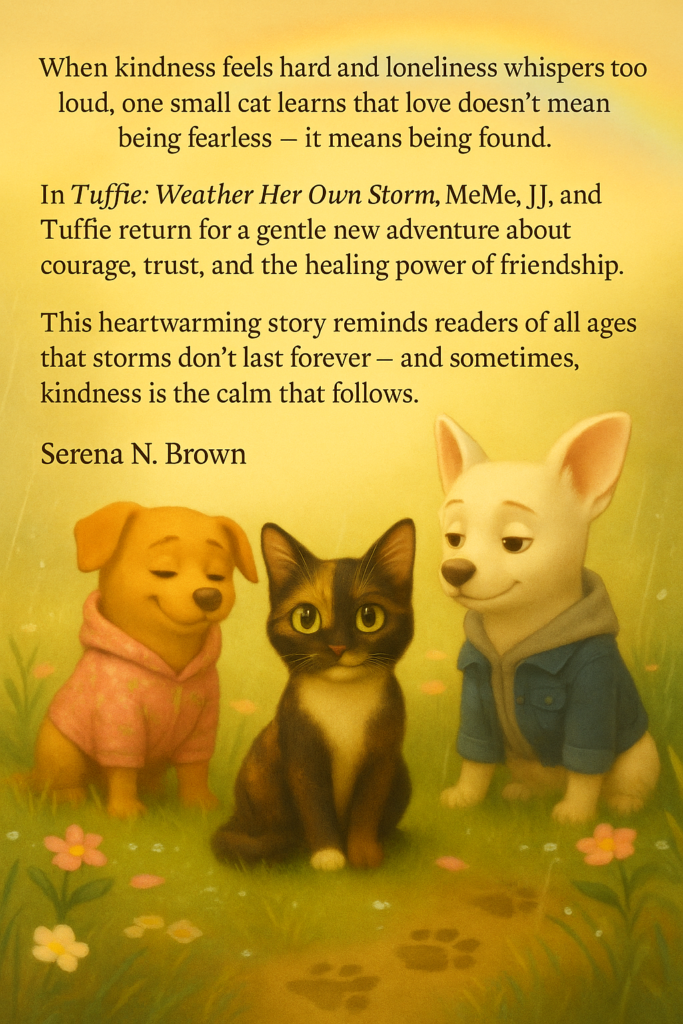
👀 3. Visual Storytelling Strengthens Emotional Memory
Children remember what they see and feel, not just what they are told.
Animal characters and emotional learning are the fabric that some animal stories use to teach children how to articulate emotions. Animal stories in particular rely heavily on:
- Body posture
- Facial expression
- Distance between characters
- Movement and positioning
These visual cues are easier for children to:
- Recognize
- Process
- Recall later
Animal characters emotional learning stories can help children notice feelings through body language, facial expression, posture, and story clues before they are asked to explain those emotions in words.
In MeMe, JJ & Friends, animal characters emotional learning moments are built around real rescue pets, giving children a safe way to observe fear, trust, patience, courage, and friendship.
🔍 4. This Is Where VNEC Changes Everything
Most emotional learning skips a step:
- It labels emotions too quickly
VNEC introduces a structured process:
Step 1: Observe (Without Words)
- What is happening visually?
- What clues are present?
Step 2: Add the Narrative
- Do the words confirm or challenge what was seen?
Step 3: Explain the Emotion
- What evidence supports the interpretation?
This method trains children to:
- Look closely
- Think critically
- Justify their understanding
🐾 5. Animals Simplify Complex Emotions
Animal characters and emotional learning strip away social complexity.
They present emotion through:
- Clear actions
- Recognizable behavior
- Simplified interactionsThis allows children to focus on:
Emotional cues
instead of
Social confusion
🔁 6. Repetition Builds Emotional Intelligence
Children return to animal stories repeatedly because:
They are engaging
They feel safe
The characters are memorable
Each reread reinforces:
Emotional recognition
Pattern detection
Understanding of cause and effect
With VNEC, repetition becomes:
progressive learning, not passive rereading
📚 7. From Storytelling to Skill Building
Without structure, a story may entertain.
With VNEC, the same story becomes:
A lesson in observation
A tool for emotional reasoning
A framework for discussion
Children move from:
Naming emotions
to
Understanding why those emotions exist
Animal characters and emotional learning are effective because they create a little distance between the child and the feeling. A child may not be ready to say, “I feel scared,” “I feel left out,” or “I do not know how to trust yet.” But that same child may be able to talk about Tuffie, MeMe, JJ, Tank, Uno, or Ricky Ticky.
This distance makes the conversation feel safer. Children can observe what the animal character does, notice how the character reacts, and talk about what might be happening inside the character’s heart. Through story, they practice empathy without feeling exposed. That is why animal stories can help children slow down, notice emotional clues, and understand feelings in a gentle way.
These small moments can become powerful emotional lessons.
Ready to Try This with a Child?
Get Your Free Detective Uno SEL Case File
Help kids practice spotting emotional clues through a fun story-based investigation inspired by the MeMe, JJ & Friends world.
✔ Helps kids identify emotional clues
✔ Encourages observation before assumptions
✔ Supports SEL + reading comprehension