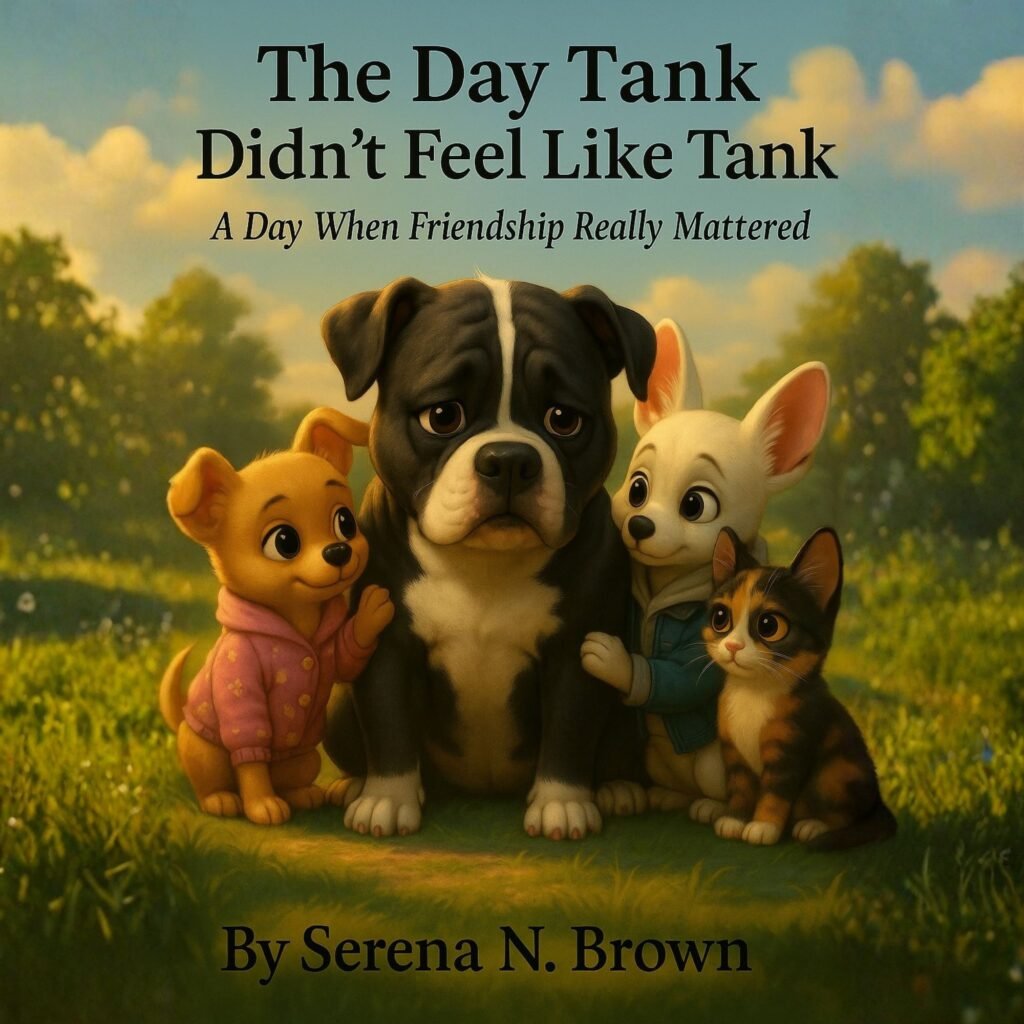
SEL Connection: Understanding Change and Big Feelings
The house that Tank still remembers is a blue house at the end of the street. This gentle children’s story explores change and healing, memories, friendship through the eyes of a rescue dog.
The others didn’t talk about it much.
Not because they forgot — but because they knew Tank hadn’t.
The house that Tank still remembers.
The blue one with the white trim. The one at the end of the street. The one with the smell of grass and peanut butter and old tennis balls.
It used to be his.
His people. His porch. His walks. His heart.
Until the day they left.
No warning. No goodbye. No bags packed where he could see.
Just silence.
Tank, the pit bull, had waited. Days. Then weeks. The Forest wrapped around him like a blanket when he broke.
But that house?
The house that Tank still remembers stayed empty.
Until now.
He didn’t mean to growl when he saw the new girl. He didn’t mean to bristle when he saw her dog.
It wasn’t them.
It was the memories.
And sometimes memories sting before they heal.
“You okay?” JJ asked, trotting up beside him.
Tank didn’t answer. He just watched.
The girl sat in the yard. Quiet. Thoughtful.
Her dog — that new one with the soft coat and calm eyes — sat beside her like they were born to wait together.
JJ tilted his head. “She kinda looks like you when you first showed up, you know?”
Tank grunted. “I don’t growl at rakes.”
“Fair,” JJ said, sitting beside him. “But she might grow on you.”
Tank didn’t respond.
But he didn’t walk away, either.
🐾 The Door to Tank’s Heart is Lexus
The Forest doesn’t erase old pain. But sometimes it helps you plant something new beside it.
Something that grows.
Lexus is the Quiet One Who Tank Didn’t know He Needed!
Understanding Tank’s Feelings
Sometimes the hardest things to carry are the things nobody else can see.
Tank wasn’t upset because someone moved into the house.
He wasn’t angry at the girl.
And he certainly wasn’t angry at her dog.
What Tank was feeling came from somewhere deeper.
The blue house, the house that Tank still remembers held memories.
It held the sound of familiar voices.
It held the smell of people he loved.
It held afternoons spent playing in the yard and evenings spent resting on the porch.
When those memories returned, they brought old feelings with them.
Many children experience something similar.
A favorite teacher moves away.
A friend changes schools.
A family moves to a new neighborhood.
A beloved pet passes away.
Even when life moves forward, memories can remain close to our hearts.
Sometimes seeing a familiar place or hearing a familiar song can bring those feelings back again.
That doesn’t mean something is wrong.
It simply means those memories mattered.
Tank was learning something important.
The Forest could not change the past.
It could not bring back yesterday.
But it could help him discover that new friendships do not erase old ones.
New beginnings do not take away the value of what came before.
As Tank watched the girl and her quiet dog sitting together in the yard, he began to notice something.
They weren’t trying to replace anyone.
They weren’t taking his memories away.
They were simply starting a story of their own.
And maybe, just maybe, there was room in his heart for that story too.
Talk About It Together
After reading Tank’s story, try asking your child:
Have you ever missed a place you loved?
Have you ever felt nervous when someone new arrived?
What helps you when you feel sad about a memory?
Can you think of a happy memory that still makes you emotional today?
How can we welcome someone new while still honoring the past?
Stories like Tank’s help children understand that feelings can be complicated. We can miss something from the past while still being excited about the future. We can feel nervous about change while also being curious about what comes next.
These are important social-emotional skills that children continue developing throughout their lives.
Tank’s story reminds us that healing is not about forgetting.
Sometimes healing begins when we realize that our hearts are big enough to hold both memories and new friendships at the same time.
Talk About It Together
After reading Tank’s story, ask your child:
Have you ever missed a place you loved?
Have you ever felt unsure about someone new?
What helped you feel better?
Can happy memories and sad memories exist at the same time?
These conversations help children build emotional awareness, empathy, and resilience.