Workplace orientation
Meet the profession, understand the work setting, learn the role, and see what will be expected on the job.
Born from the Forest of Friends storybooks
Career-Infused Learning began when a Forest of Friends story problem became a real-workplace learning experience. Students enter the profession, complete orientation, learn safety first, and discover the full range of school subjects and concepts already embedded in the job.

From first day to applied work
The experience follows the order of a real job. Students first understand the workplace and their role, complete safety preparation, and then use academic subjects to perform the work.
Meet the profession, understand the work setting, learn the role, and see what will be expected on the job.
Complete dedicated safety learning on PPE, hazards, procedures, reporting, and responsible workplace decisions.
Discover the academic, technical, civic, creative, and professional concepts the selected job naturally requires.
Learn visually and through hands-on experiments, workplace documents, videos, books, presentations, and authentic professional tasks.
The complete learning pathway
Each pathway moves students from an engaging entry point into safe, standards-aligned professional work and produces visible evidence of learning.


Then academics enter the work
The screen pairs a subject or concept with the profession: Scientific Observation + Veterinarian, Fractions + Carpenter, or Fractions + Chef. Those labels introduce the connection; they do not limit the curriculum. Each profession can expose students to different levels and combinations of literacy, mathematics, science, economics, government, history, geography, technology, ethics, law, and other concepts used in the work.
Examples, not curriculum boundaries
The subjects used change with the profession, grade level, workplace problem, and employer input.
| Profession | Subjects and concepts used in the work |
|---|---|
| Veterinarian | Biology, anatomy, measurement, ratios, literacy, ethics, public health |
| HVAC technician | Algebra, physics, energy, measurement, technology, technical reading, safety |
| Real estate investor | Economics, government, law, finance, statistics, building science, communication |
| Land surveyor | Geometry, trigonometry, geography, technology, property law, technical writing |
| Chef | Fractions, ratios, chemistry, literacy, culture, business, food safety |
| Maintenance manager | Engineering, data analysis, systems thinking, planning, safety, professional communication |

Featured story-to-career pathway
A moment from Book 5 becomes the entry point—not the endpoint. Students move from Tank’s household-pet visit into a wider investigation of veterinary medicine.
Tank needs help and visits the veterinarian.
Compare household veterinary care with zoo veterinary care.
Examine handling risks, PPE, animal scale, anatomy, and biological similarities.
Calculate medication amounts, interpret evidence, and prepare a professional response.
Explain, revise, apply, and produce visible evidence of learning.


After orientation and safety
K–5 SUBJECT-TO-CAREER CONNECTIONS
Age-appropriate career contexts give reading, writing, math, science, and social studies an immediate purpose.
Sample career contexts
Observe symptoms, compare animal anatomy, calculate medication, interpret charts, evaluate safety differences, and communicate a professional response.
Examples expand by grade level, career problem, and employer input.Career learning grows into postsecondary readiness
Career-Infused Learning develops the language, confidence, planning habits, and workplace understanding students will need for college, technical school, apprenticeships, scholarships, and employment.
One higher-level word a day progresses from A through Z. Students learn the definition, use it in a sentence, and meet the word in academic or professional context—building familiarity with language they may encounter in secondary coursework and on the SAT or ACT.
Students advance from Apprentice Observer to Apprentice Helper and Emerging Professional while completing deeper subject-to-career tasks across multiple professions.
Postsecondary preparation is embedded into the career pathway so students connect present academic choices with future programs, credentials, applications, scholarships, and career routes.

Inside the learning system
The platform connects curriculum, college and career readiness, assessment, coaching, accessibility, and progress evidence. Explore one layer at a time.
Students encounter multiple professions across the grades while moving into more complex roles, academic applications, and professional decisions.

Two examples from the learning platform
A chef can use fractions, chemistry, explanatory writing, business, and cultural history. A real-estate investor can combine economics, government, law, finance, statistics, building science, research, and persuasive communication.


Local industry completes the model
Once a profession is selected, the pathway is informed by people doing that work in the community—not only by a textbook description of the career.
Start with local workforce priorities, student interests, or a career pathway the school wants to strengthen.
Reach employers through direct contact, existing school relationships, workforce partners, or the local Chamber of Commerce.
Use interviews, workplace videos, tools, procedures, and professional insight to understand what the job truly requires.
Turn authentic job issues into standards-aligned learning tasks while preserving safety, accuracy, and local relevance.
Pricing for schools and districts
Start with the level of implementation you need.
Career-Infused Learning can be licensed for one school, expanded with safety and digital resources, or implemented across a district. Custom pathways and professional development can be added as needed.
School-level access to the Career-Infused Learning model and implementation resources.
Career-infused curriculum plus workplace safety and digital learning resources.
District-scale implementation shaped around grade levels, pathways, schools, and rollout needs.
A profession-specific pathway developed around authentic work, academic connections, and local priorities.
Training and implementation support for educators, schools, and partner organizations.
Final pricing may vary based on enrollment, number of schools, grade span, implementation scope, customization, professional development, and digital licensing needs.
Decision proof for schools and districts
Before a school or district defines scope, reviewers can see what implementation includes, examine a profession-based sample, and verify the program's presentation and build evidence.
The sample connects workplace orientation, safety demands, animal scale, treatment decisions, shared anatomy, academic concepts, and authentic professional reasoning.
Request a sample pathway ↗Designed from education and industry
The work brings together instructional design, business, engineering technology, marine electrical experience, real estate, workplace safety, and character-led learning.


What a partner can receive
Begin with something concrete
Schools and districts can request a sample for elementary, middle, or high school students. See how academic standards, workplace safety, career-specific tasks, hands-on learning, and assessment evidence connect within a real profession.
On the contact form, select Request a Sample Career Pathway.
Go to the contact form ↗We will follow up about the students served, career interest, and type of support needed.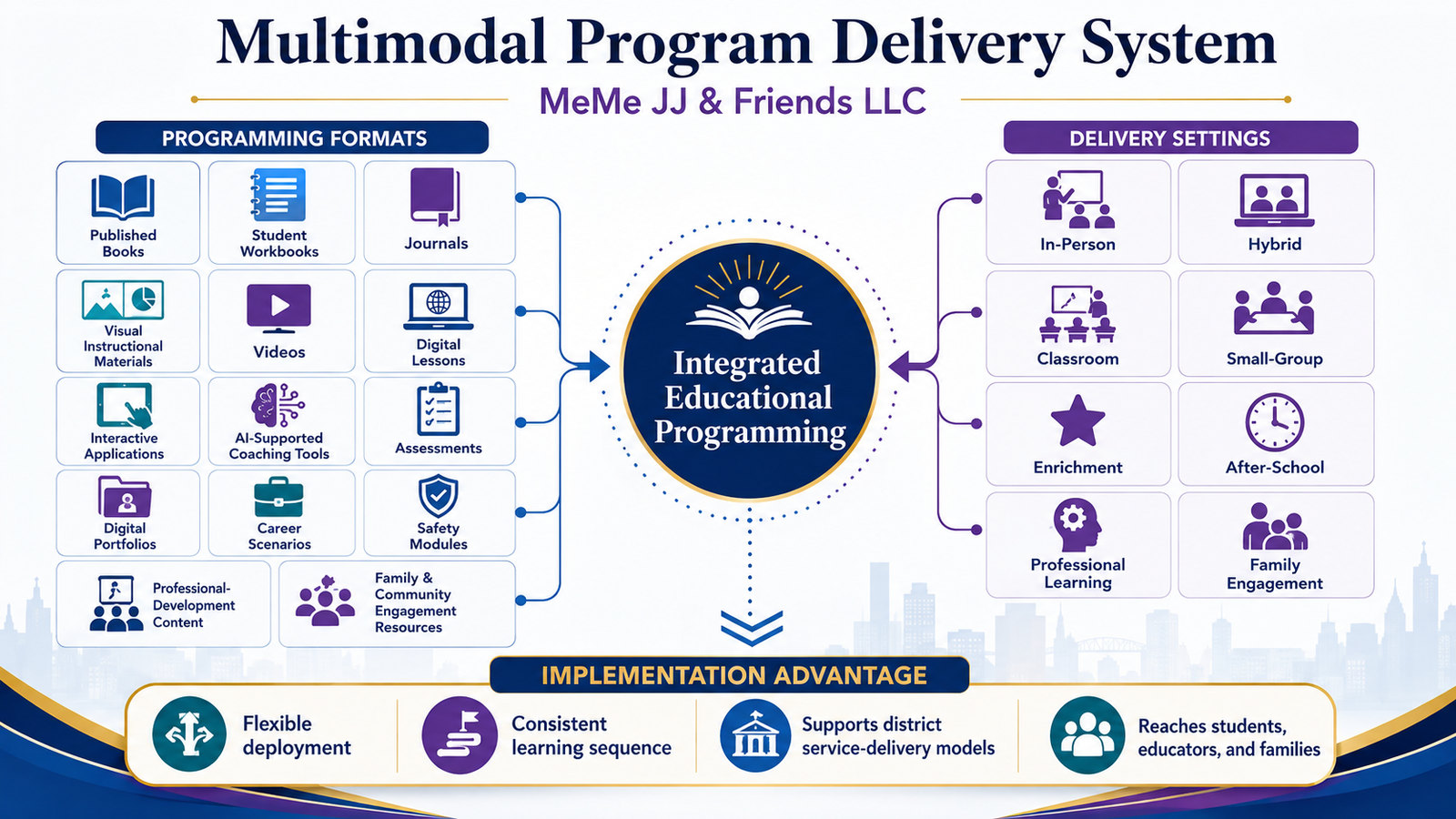
See the model before you request it
See how one instructional framework moves across professions, workplace safety, academic integration, technical literacy, and multimodal learning—using veterinarian and HVAC examples.
No form required to view the sample. Request a full grade-level or profession pathway when you are ready to go deeper.
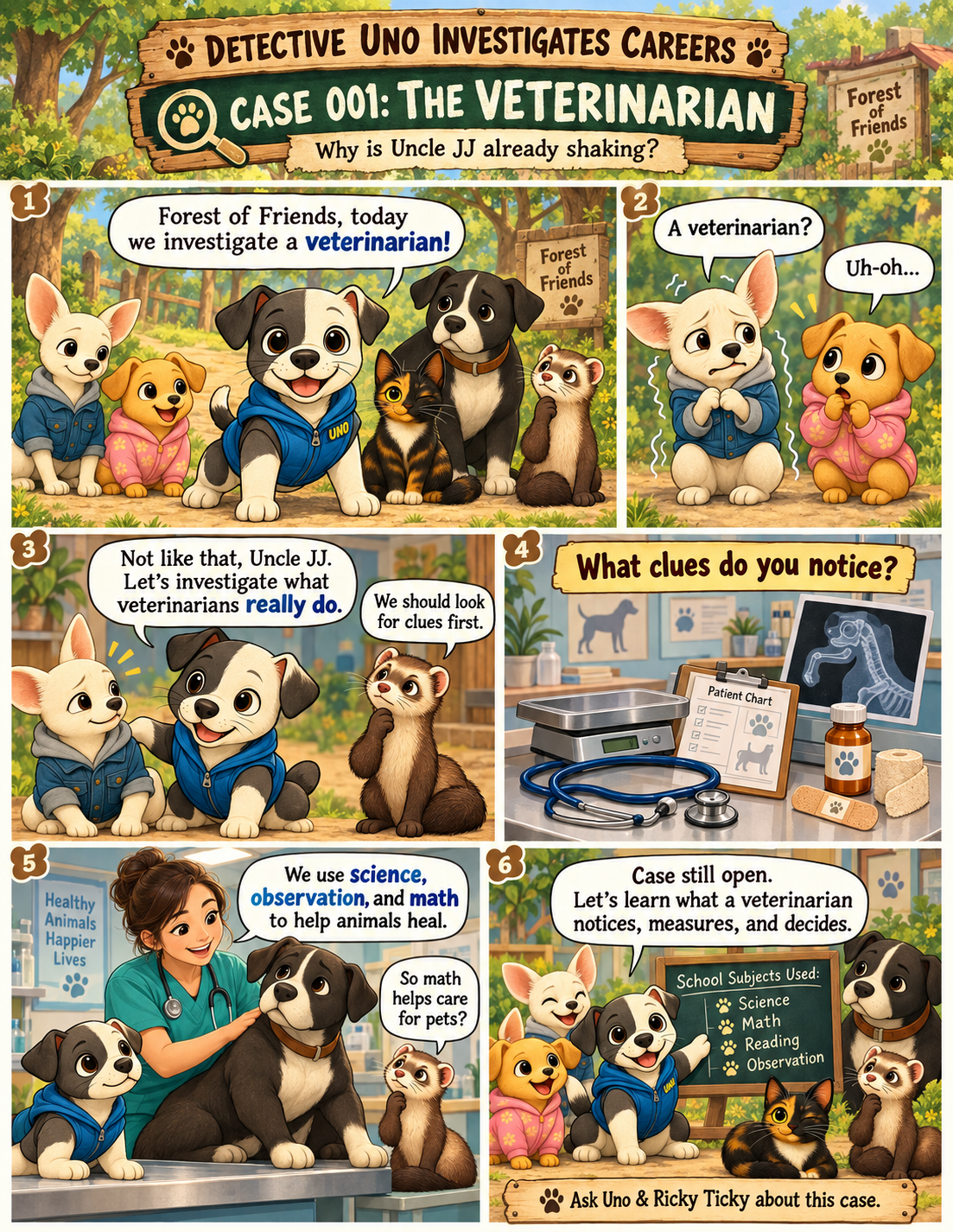
Detective Uno Investigates Careers
Case 001: The Veterinarian — Why is Uncle JJ already shaking?
Follow Detective Uno and Ricky Ticky as they investigate what veterinarians notice, measure, read, and decide. The comic opens the case; the learning experience connects the profession to real school subjects and evidence-based thinking.
This is the first case in the growing Detective Uno Investigates Careers series.